

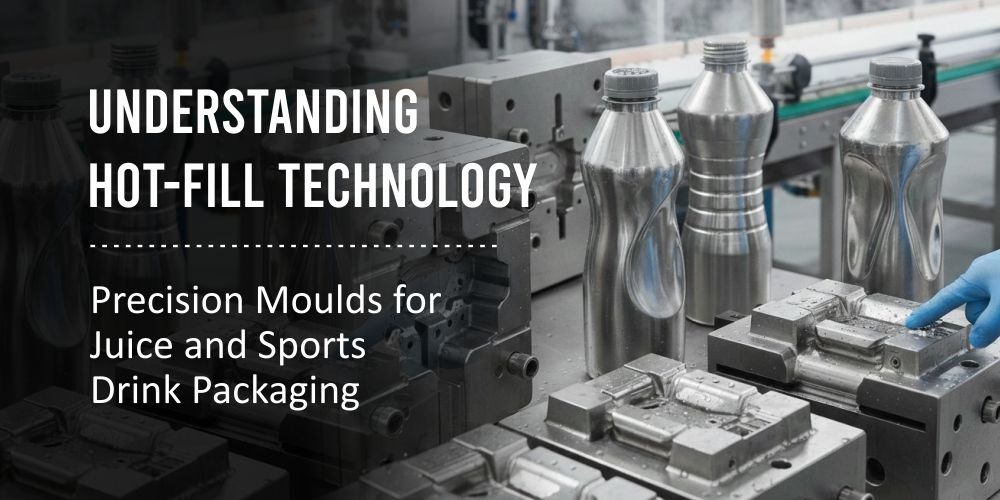
In the competitive beverage industry, maintaining product freshness without artificial preservatives is the ultimate goal. For manufacturers of fruit juices, nectars, and isotonic sports drinks, Hot-Fill Technology is the industry standard. However, the success of this process doesn’t just depend on the filling line—it starts with the engineering of the bottle itself.
As a pioneer in PET blow moulds, Awanti Polymoulds specialises in high-precision solutions for heat-resistant PET bottles. In this guide, we explore the specific requirements for hot-fill packaging and why specialised mould design is critical for your production line.
What is Hot-Fill Technology?
Hot-filling is a sterilisation process in which the beverage is heated to temperatures between 85°C and 92°C before being bottled. The heat of the liquid itself sterilises the interior of the PET bottle and the closure (cap).
While effective for food safety and shelf-life, this process poses a massive challenge: Standard PET bottles soften at approximately 76°C. Without specialised engineering, a regular bottle would collapse or deform under the thermal stress and subsequent vacuum pressure.
Specific Requirements for Heat-Resistant PET Bottles
To survive the hot-fill process, PET bottles must be “Heat-Set.” This requires a combination of advanced material science and precision mould engineering.
- 1. Thermal Stability through Heat-Setting
During the blow moulding process, Awanti’s advanced moulds use a Heat-Set (HR) process. Unlike cold-set moulds that chill the plastic instantly, hot-fill moulds are heated (often up to 140°C). This induces thermal crystallisation, rearranging the PET molecules into a more stable structure that can withstand high filling temperatures without shrinking.
- 2. Vacuum Compensation Panels
As the hot liquid cools, it contracts, creating a vacuum inside the sealed bottle. Heat-resistant bottles are designed with structural vacuum panels or “ribs.” These features allow the bottle to flex inward in a controlled manner, preventing the container from becoming permanently distorted or “ovalizing.”
- 3. Reinforced Neck Finishes
The neck of a hot-fill bottle is a critical failure point. To prevent the “mouth” of the bottle from warping under the heat and the pressure of the capping machine, many hot-fill bottles utilize crystallized necks (which appear opaque white) or reinforced resin blends to ensure a perfect, leak-proof seal.
- 4. Optimized Wall Thickness (Grammage)
Hot-fill bottles generally require a higher weight (grammage) compared to standard water bottles. Precision mould manufacturing ensures uniform wall thickness distribution, which is vital for maintaining structural integrity during the rapid cooling phase in the cooling tunnel.
Why Choose Awanti Polymoulds for Hot-Fill Solutions?
At Awanti Polymoulds, we don’t just manufacture moulds; we engineer performance. Our hot-fill mould solutions offer:
- Precision Engineering : Accuracy measured to the thousandth of a millimetre to ensure consistent bottle quality.
- High-Efficiency Cooling Channels: Strategically placed channels to manage the thermal cycle and optimise production speeds.
- Custom Bottle Design: Our team works with global brands like Coca-Cola and Parle Agro to create functional, aesthetically pleasing hot-fill designs that reduce material waste while maintaining strength.
- Durability: Built using high-grade materials to ensure your moulds last for millions of cycles.
The Benefits of Hot-Fill PET vs. Glass
While glass was once the only option for hot-fill, Heat-Set PET offers several advantages:
- Cost-Effective: Lower production and shipping costs due to reduced weight.
- Shatter-Proof: Enhanced safety for the end consumer.
- Design Freedom: Greater flexibility in bottle shapes and branding.
- Sustainability: PET is 100% recyclable, and Awanti is a leader in sustainable PET manufacturing.
Are you looking to optimise your beverage packaging line? Contact Awanti Polymoulds today to discuss your custom hot-fill PET mould requirements. Our experts are ready to help you design a bottle that stands up to the heat.