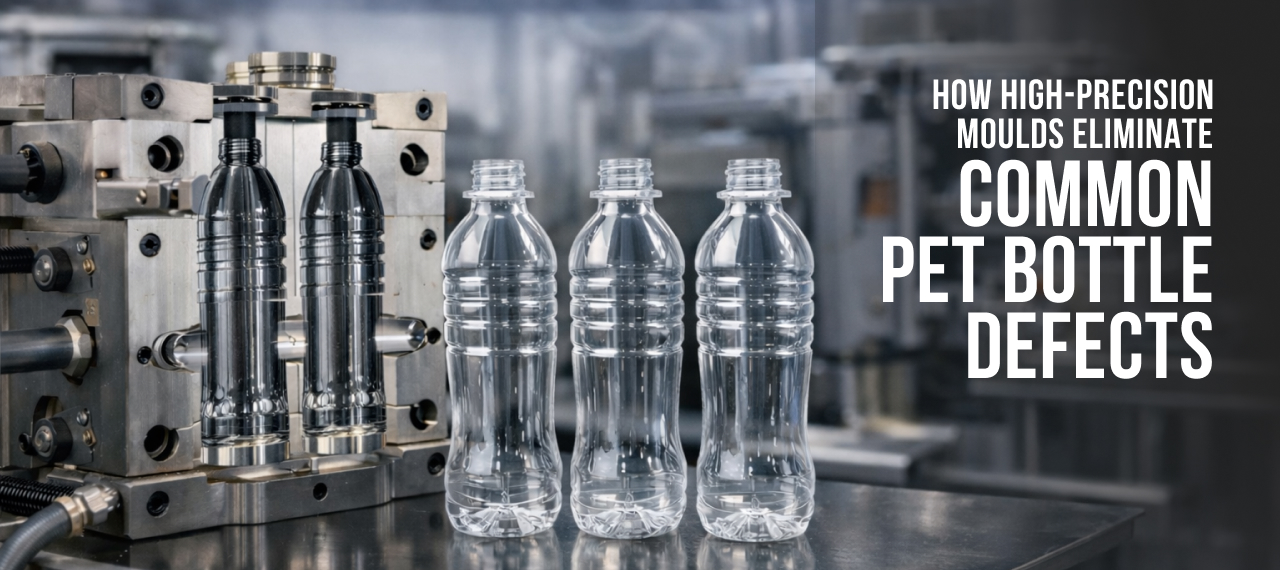
In PET bottle manufacturing, even minor errors can lead to major production losses. Common PET bottle defects such as pearlescence, flash, and uneven wall thickness not only affect quality but also increase rejection rates. Effective stretch blow moulding troubleshooting starts with one critical factor—mould precision.
At Awanti Polymoulds, we know that mould efficiency is the silent engine behind every successful production run. When your equipment is optimised, material saving in blow moulding becomes a natural outcome rather than a constant struggle.
7 Common PET Bottle Defects & The Mould Quality Connection
Even the most advanced blow moulding machines can’t compensate for a mediocre mould. Here is how mould precision directly impacts the most common PET bottle defects.
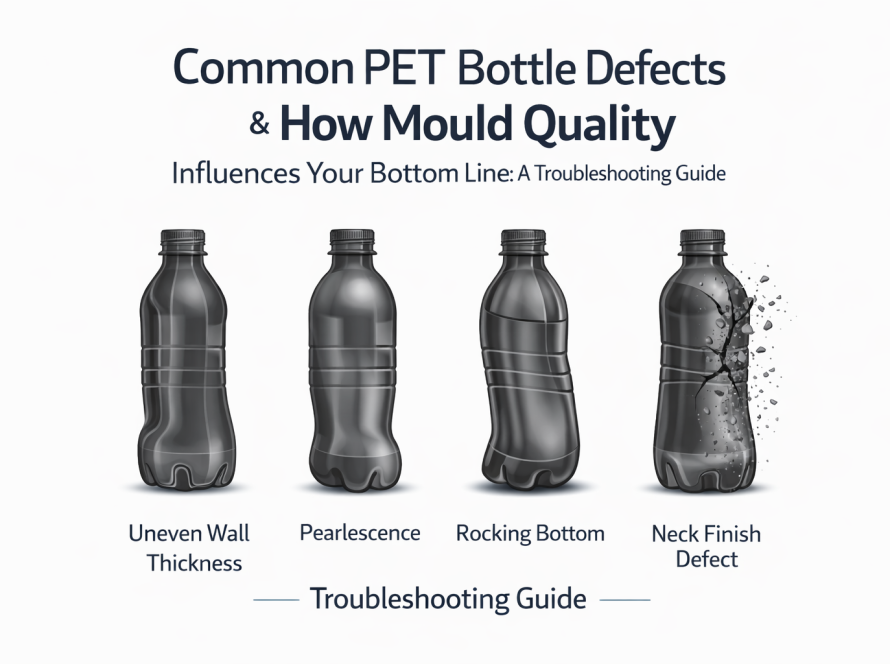
- 1. Pearlescence (Over-stretching) : This "whitish" appearance occurs when the PET material is stretched beyond its natural limit. While often a temperature issue, a poorly designed mould cavity can cause uneven heat dissipation, forcing the material to stress.
- 2. Thin Bases or Heavy Shoulders : If your material distribution is "off," check your mould's cooling channels. Mould precision ensures that the base area is cooled exactly as designed, preventing the material from sagging or thinning out during the blow cycle.
- 3. Off-Centre Gate : A classic stretch blow moulding troubleshooting headache. If the part isn't centred perfectly within the mould, the gate will shift. High-quality moulds feature precision-engineered centring mechanisms to ensure the stretch rod hits the "bullseye" every time.
- 4. Flash at the Parting Line : When the two halves of a mould don't meet with absolute "metal-to-metal" perfection, excess plastic escapes, creating a sharp "flash." Precision-ground parting lines are essential for a seamless finish.
- 5. Poor Neck Finish : If the neck is leaking or the cap won't fit, the mould’s neck ring is likely the culprit. Even a tiny deviation in the thread profile can lead to massive rejection rates.
- 6. Body Creasing (Foldover) : This usually happens when the preform is too hot, or the blow pressure is mistimed, but a "cold spot" in a low-quality mould can also cause the material to fold rather than flow.
- 7. Dimples and Vacuum Collapse : If the bottle walls cave in after cooling, it’s often a sign that the mould’s cooling system is inefficient. High-performance moulds use advanced alloys and cooling layouts to ensure the plastic sets instantly in its intended shape.
Reducing Scrap Rates: The ROI of High-Precision Moulds
Every defective bottle is more than just wasted plastic; it’s wasted energy, wasted machine time, and lost profit.
The Precision Advantage: A mould engineered with mould efficiency in mind can reduce scrap rates by up to 15%. Over a year of high-volume production, that equates to tons of resin saved.
- Consistency is Key : High-precision moulds offer "cavity-to-cavity" consistency. This means once you've dialled in your settings, every single bottle—whether from cavity 1 or cavity 48—is identical.
- Faster Cycle Times : Better cooling designs allow you to eject the bottle sooner without risking deformation, increasing your hourly output.
- Reduced Wear and Tear : When a mould is built with superior metallurgy and alignment, it lasts longer and requires less frequent maintenance, further contributing to material savings in blow moulding.
Why Choose Awanti Polymoulds?
At Awanti Polymoulds, we don’t just manufacture tools; we engineer solutions for stretch blow moulding troubleshooting. Our commitment to mould precision ensures that your production line stays up and running with minimal interruptions.
By investing in quality at the start, you eliminate the hidden costs of high scrap rates and material waste.
Facing frequent PET bottle defects or high rejection rates?
Partner with Awanti Polymoulds to eliminate defects through high-precision mould engineering.
Contact us today to improve your production efficiency and reduce scrap.
Frequently Asked Question on PET Bottle Defects
PET bottle defects are usually caused by improper temperature control, uneven material distribution, poor mould design, or incorrect machine settings during the blow moulding process.
High-precision mould design ensures uniform cooling, accurate material flow, and perfect alignment, which helps minimise defects like flash, uneven thickness, and deformation.
One of the most common blow moulding defects is pearlescence (whitening), caused by over-stretching of PET material due to improper temperature or mould conditions.
Scrap can be reduced by using high-quality moulds, maintaining proper temperature and pressure settings, optimising preform design, and ensuring regular machine and mould maintenance.