In today’s high-speed global market, where consumer demands shift almost daily, a manufacturer’s ability to adapt is its most valuable asset. The days of long production runs and slow, cumbersome changeovers are over. To thrive, companies must embrace Production Flexibility and Manufacturing Efficiency. The key to unlocking this agility lies in implementing a Quick Mould Change (QMC) System.
As a leading PET Blow Moulds Manufacturer in India, Awanti Polymoulds specialises in providing high-precision solutions that meet the demands of global beverage, pharma, and home-care industries. We understand that your profitability hinges on speed and adaptability. This blog explores how QMC systems revolutionise production, turning downtime into output.
From Hours to Minutes: Understanding Quick Mould Change (QMC)]
What exactly is a Quick Mould Change System? It is a methodology and set of integrated components designed to drastically reduce the time required to switch a mould or die on a machine. This process is rooted in the principles of SMED (Single-Minute Exchange of Dies), a core pillar of Lean Manufacturing.
Traditionally, a mould change could involve manual setup, heavy lifting, complex clamping, and tedious connection of utilities—a process often taking hours of costly Downtime. A QMC system transforms these internal tasks (machine stopped) into external tasks (machine running) by utilising:
- Fast Clamping Systems: Such as hydraulic, pneumatic, or magnetic clamping.
- Automatic Couplers: For instantaneous connection of water, air, and electrical circuits.
- Mould Handling Equipment: Like mould carts and change tables for safe, rapid transfer.
The New Era of Agility: QMC’s Impact on Production Flexibility]
The adoption of QMC systems yields strategic benefits that go far beyond simple time savings, fundamentally redefining your company’s production capabilities.
1. Enabling Small Batch Runs and JIT Manufacturing]
The market now demands product variety and customisation. QMC systems make it profitable to run Small Batch Sizes or shorter production cycles.
- Just-In-Time (JIT) Manufacturing: By making changeovers fast and easy, QMC allows you to produce exactly what the customer needs, when they need it. This significantly reduces inventory carrying costs and obsolescence risk.
- Rapid Product Introduction: You can quickly switch to manufacturing a new bottle design for a seasonal campaign or a new product line without a major production disruption.
2. Maximizing Machine Utilization and OEE]
The most direct benefit of QMC is the boost to your machine’s Overall Equipment Effectiveness (OEE).
- Reduced Downtime: By cutting mould change time from, say, 120 minutes to less than 15 minutes, the machine spends more time running and producing.
- Increased Productivity: More production cycles in a shift translates directly into a Higher Output and a greater return on your machinery investment.
3. Enhancing Safety and Precision
Automation and standardised processes minimise reliance on manual labour, reducing the risk of human error and operator injury.
- Consistent Clamping: Automated clamping systems ensure uniform force and precise mould alignment every time, which is critical for maintaining Product Quality and mould longevity.
- Operational Safety: Sensors and interlocks prevent the machine from starting until all clamps and connections are secured, creating a safer work environment.
Awanti Polymoulds: Your Partner in QMC and PET Mould Excellence
At Awanti Polymoulds, we are at the forefront of providing the components you need to achieve world-class production flexibility. Specializing in precision PET blow moulds, we understand that the mold itself must be designed for rapid exchange.
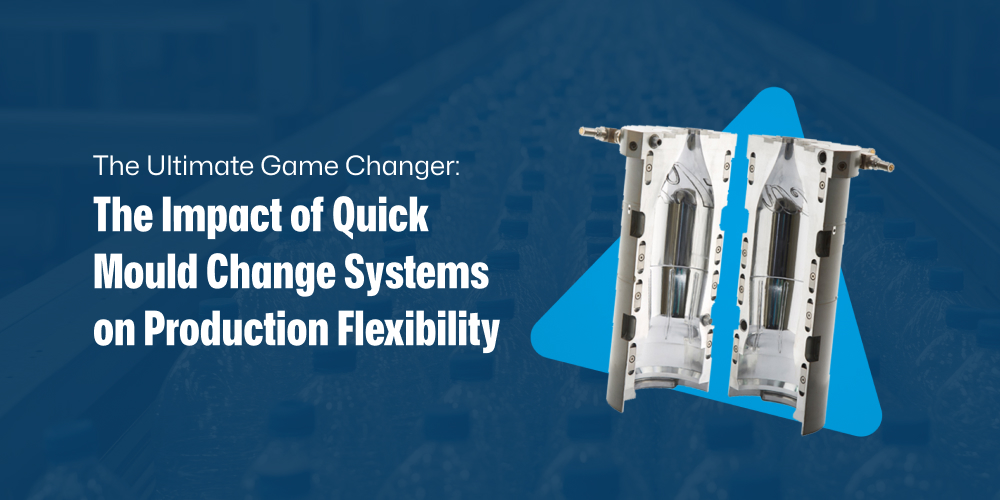
Our featured product, the Quick-Change Moulds, is engineered for seamless integration with high-speed rotary and linear blowing machines, compatible with leading global blowing lines.
We offer an end-to-end solution for our customers, ensuring a perfect fit with your QMC strategy:
- Bottle Designing: Creating optimized designs for lightweighting and performance.
- Mould Manufacturing: Using advanced CNC machinery to ensure High Accuracy and Durability.
- Quick Change Integration: Our moulds are built with features that support automatic clamping and centralised connection systems, allowing you to realise the full potential of Single-Minute Exchange of Dies (SMED).
The Future is Flexible: Invest in QMC Today
The choice to implement a Quick Mould Change System is not just a tactical improvement; it is a Strategic Necessity for any manufacturer aiming for global competitiveness. It is the definitive path to achieving genuine Production Flexibility, higher profits, and a manufacturing environment ready for the challenges of Industry 4.0.
Ready to transform your production line with the most durable and high-speed Quick-Change Moulds?
Contact Awanti Polymoulds—The Best Mould Manufacturing Company in India—to discuss a customised QMC solution for your specific needs.
FAQ's
What is PPO injection moulding?
PPO injection moulding is the process of shaping Polyphenylene Oxide (PPO) — a high-performance engineering plastic — into precision components using controlled heat and pressure.
What are the advantages of PPO plastic?
PPO offers excellent thermal stability, dimensional accuracy, electrical insulation, and chemical resistance, making it ideal for automotive, electrical, and industrial applications.
What industries use PPO injection moulded parts?
Industries such as automotive, electrical, electronics, and fluid management rely on PPO moulded components for high durability and performance.
How does PPO differ from other plastics like PP or PET?
Unlike PP or PET, PPO can withstand higher temperatures and offers superior strength and electrical properties, suitable for high-performance and engineering-grade applications.
Can PPO be blended for better mouldability?
Yes. PPO is often blended with High Impact Polystyrene (HIPS) to form modified PPO (mPPO), improving flow, processability, and surface finish during injection moulding.
What moulding conditions are ideal for PPO?
PPO requires a high injection temperature (240–300°C) and mould temperature (100–150°C) to ensure smooth flow and avoid defects like warpage or delamination.
Does Awanti Polymoulds handle PPO mould manufacturing?
Yes, Awanti Polymoulds specializes in high-precision moulds for advanced materials, including PPO, PP, and PET, offering end-to-end tooling solutions across India.